
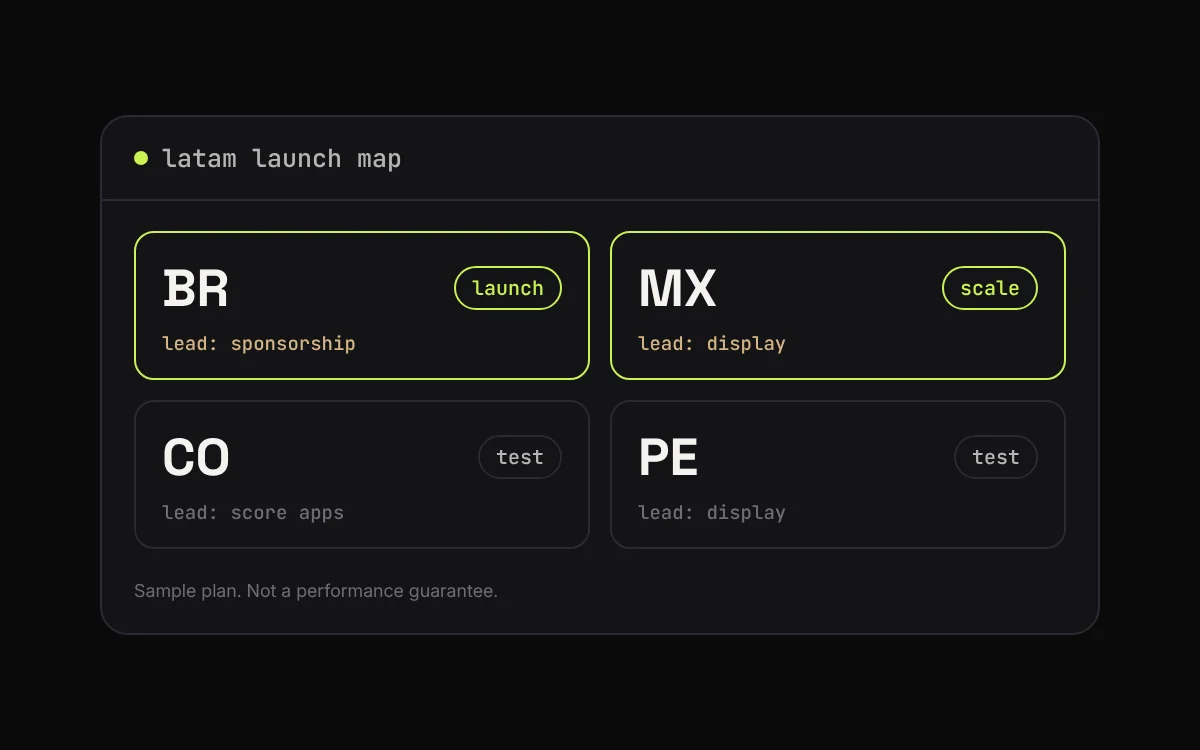
LatAm is not one sportsbook market. Countries differ in regulation, licensing, tax, payment behavior, sports culture, media consumption, language, offer expectations, and the maturity of local operators. A regional deck can be useful for coordination, but it cannot replace a market brief.
This framework avoids country-specific legal claims because those details change and require current local advice. Its purpose is to organize the questions that media, sponsorship, product, compliance, and measurement teams need to answer together.
Start with a launch gate for each country
Record the licensed entity, permitted product, eligible geography, legal age, advertising restrictions, required responsible gambling treatment, offer rules, data and consent requirements, payment readiness, and the owner of final sign-off. Note application or transition periods separately from full authorization.
The gate should produce a clear status: ready to brief, blocked, or ready with conditions. Do not ask media partners to solve unresolved licensing or product questions. Likewise, do not let a broad regional approval imply that every local creative, creator, and placement is covered.
Build a local audience and product picture
Identify the sports, competitions, teams, viewing habits, devices, payment methods, and product behaviors relevant to the market. Map the operator's actual strengths. A familiar European football message may travel well in one audience and feel generic in another where local leagues, combat sports, basketball, racing, or other interests create stronger attention.
Use local language and local judgment. Translation can preserve meaning while losing tone, offer clarity, or responsible advertising context. Review the landing journey, account flow, verification, deposit, support, and product experience on the devices and connections people will use.
Map publisher supply before committing to a regional volume
Request property-level data for each country: audience geography, age suitability, device mix, sports context, direct seller relationship, available formats, reservation windows, historical delivery, reporting, and whether traffic is owned, syndicated, or extended through other supply.
A regional publisher can simplify coordination, while a local specialist may provide stronger context and trust. The right mix can use a regional anchor with country-specific properties. Keep the seller and placement visible so performance is not averaged into a regional number that hides weak or ineligible markets.
Use sponsorships where the brand can earn a local role
A sponsorship should connect the operator to something useful in the local sports experience: a match center, data feature, analysis format, recurring show, community event, or coverage package. Rights, creative, distribution, and responsible advertising treatment need market-specific review.
Check whether the audience and rights extend beyond the licensed territory. Define localization, suppression, alternative branding, content archive, and what happens if the regulatory or sports calendar changes. A cross-border audience can be commercially attractive and operationally awkward at the same time.
Keep measurement local enough to support a decision
- Delivery: market, publisher, placement, device, format, frequency, viewability, and eligible reach
- Journey: qualified visits, page performance, registration, verification, payment success, and product entry
- Economics: local media cost, incentives, payment cost, fraud and risk treatment, cohort quality, and contribution
- Learning: creative, sports context, publisher, offer, timing, and operational changes worth carrying into the next market
Use a shared framework across the region but do not force identical targets where the economics, product, or market maturity differ. Regional reporting should make differences easier to see, not turn them into one blended average.
Impressax can combine direct media traffic with publisher sponsorships around a market-specific brief. The iGaming KPI framework provides a common reporting spine without erasing local differences.
Before booking inventory, compare the seller route and the placement-level evidence. For the next planning decision, read How sportsbooks advertise on livescore apps.