
Moving display spend out of an open buying route is easy to describe and harder to evaluate. A proposal can name a recognisable sports publisher and promise a cleaner path, while leaving the operator with less useful acquisition reporting than it had before. The point of a direct test is not simply to remove intermediaries. It is to make the placement, cost and result easier to inspect.
This guide sets out a practical way to move a controlled share of budget without changing the definition of success halfway through. It is written for licensed casino and sportsbook teams comparing display placements. It does not assume that direct inventory outperforms programmatic buying, or that one publisher's audience is suitable for every market.
What changes when display budget moves from programmatic to direct?
Start with the commercial relationship. Who sells the inventory, who owns the audience environment, and who is responsible if delivery differs from the booking? In a direct plan, those answers should be documented alongside the property, format, market and flight dates. A familiar publisher name on a slide is not a substitute for a named placement in the agreement.
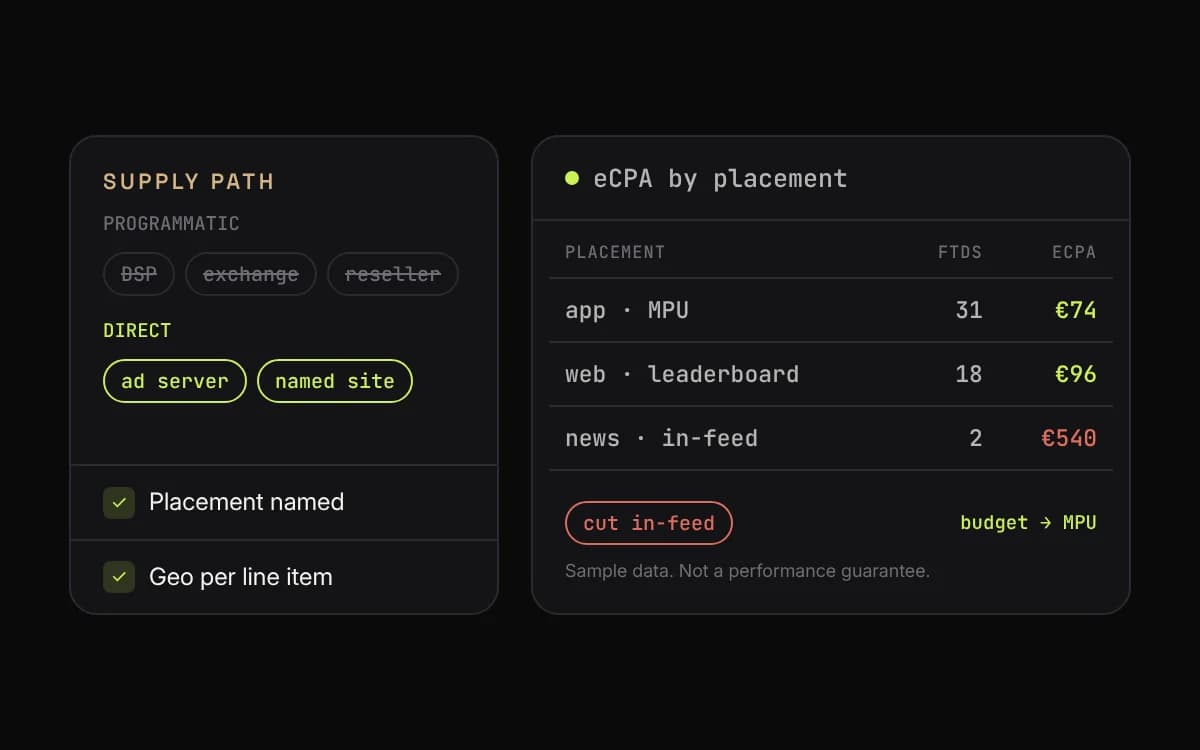
Direct and programmatic are not opposites. A direct agreement can still use programmatic technology. The crossed-out chain in the supplied diagram illustrates a shorter buying route, not a claim that every direct campaign removes every technology platform. Ask for the actual route and any fees included in the quoted price.
Impressax's iGaming media traffic service starts with named publisher environments, formats and campaign windows. The same planning discipline applies whether the test uses a fixed booking, CPM delivery or a combination of placements.
How do you keep CPA comparable across buying routes?
Write down the denominator before comparing costs. A registration, a verified account and a first-time depositor are different events. They can have different approval criteria and reporting delays. If one route reports registrations and another reports first-time depositors, the two CPA figures do not answer the same question.
CPA = included campaign cost ÷ acquisitions under the agreed definition. For an FTD-based comparison, use the same operator-approved definition of a first-time depositor throughout. If a placement has no attributed acquisitions, show the spend and zero acquisitions; do not report a zero CPA.
| Field | Agree before launch | Why it matters |
|---|---|---|
| Acquisition event | Registration, verified account or FTD, with the same eligibility rules | Different events produce different denominators. |
| Attribution | Window, click/view treatment and deduplication method | A change in attribution can change reported CPA without changing delivery. |
| Cost basis | Media, fees, production and other included costs | A media-only figure is not comparable with an all-in figure. |
| Audience and timing | Licensed market, device, campaign dates and reporting time zone | Different populations and periods can obscure the result. |
| Data maturity | Reporting lag and the date on which a cohort is reviewed | Recent acquisitions may still be incomplete or subject to validation. |
Keep the original campaign baseline. Record which costs it includes and any limits in its attribution. A new publisher report should not silently replace the operator's acquisition record. If the old route cannot expose placement-level detail, mark that gap rather than creating a precision the baseline never had.
What reporting should a direct publisher placement provide?
Give every booked placement a stable identifier that appears in the media plan, tracking links and report. Agree the available breakdowns before launch: property, placement, creative, device, market and date. Not every environment supports every field, so the proposal should say what can and cannot be delivered.
The publisher or ad server records delivery. The operator records acquisition events. Keep those responsibilities distinct and agree how the records will be joined or compared without sharing unnecessary personal data. Where attribution cannot reliably connect an acquisition to a placement, show that limitation in the scorecard.
For programmatic supply checks, IAB Tech Lab's ads.txt guidance explains how publishers declare authorised sellers. Its sellers.json and SupplyChain guidance addresses seller identities and intermediaries. These are supply-transparency checks, not proof of traffic quality, regulatory eligibility or a low CPA.
How should you read the placement-level eCPA example?
The supplied artwork shows sample data. The table below repeats it as readable HTML; it is not an Impressax result, a market benchmark or a performance guarantee. FTD means first-time depositor here, under a hypothetical consistent acquisition definition.
| Placement | Sample FTDs | Sample eCPA | Question for the review |
|---|---|---|---|
| App · MPU | 31 | €74 | Is acquisition quality comparable, and is more delivery available? |
| Web · leaderboard | 18 | €96 | Does the result remain acceptable after the cohort matures? |
| News · in-feed | 2 | €540 | Is tracking sound, and is there enough evidence to stop or retest? |
The diagram flags in-feed for a cut and points budget toward the MPU. Treat that as an illustration of a possible review decision, not a rule to follow from two conversions. Before reallocating, check spend, cohort maturity, attribution, acquisition quality and the decision threshold agreed for the test. A low CPA from unsuitable or unvalidated acquisitions is not a useful win.
How do you move budget without losing the baseline?
Choose one business question and a bounded test. For example: can a named sports placement acquire eligible players at an acceptable cost under the existing attribution method? Keep as many other variables stable as practical. Changing the market, offer, landing page and acquisition definition at the same time makes the buying-route comparison difficult to interpret.
Set the budget cap, reporting cadence and minimum evidence for a decision before the first impression. Where practical, preserve a comparable baseline or control, and record differences in dates, audience and delivery. Agree who can pause the campaign if tracking, market eligibility or delivery fails.
Confirm the creative specification for each placement rather than resizing one asset blindly. The banner ads in iGaming guide covers common sizes and format decisions. Publisher acceptance and the operator's market-specific approvals still need to be checked for the actual campaign.
What do you do when the reports disagree?
Keep a discrepancy log. Publisher clicks, operator sessions and attributed acquisitions measure different stages, so they should not be forced to match. Review time zones, redirects, consent behaviour, repeated clicks, invalid-traffic filtering and attribution cut-offs. If a problem changes the denominator materially, pause the comparison until the issue is understood.
Record each change to creative, targeting, pacing or tracking with its date and reason. The final review should distinguish what was observed, what remains uncertain and what decision the evidence supports. Do not smooth away an unresolved reporting gap with a blended campaign average.
When is a direct publisher test ready to scale?
Scale only when the placement has met the agreed delivery, measurement and acquisition-quality criteria, and the publisher can supply the next increment of suitable inventory. More budget can change the audience mix and cost. Confirm the next booking rather than assuming the first test's CPA will repeat.
A useful outcome may also be to stop, fix tracking or run a narrower second test. Direct buying earns its place in the media mix when the operator can explain what was bought, how it was measured and why the next decision follows. A cleaner supply path helps that explanation; it does not replace the evidence.
Common questions
Does direct publisher advertising always reduce CPA?
No. A clearer buying route can improve visibility into placements, costs and responsibilities, but acquisition performance still depends on audience fit, creative, the offer, landing pages and measurement. Compare results from a controlled test rather than assuming direct buying will be cheaper.
What is the difference between CPA and eCPA?
CPA is cost per acquisition: the included campaign cost divided by the number of acquisitions under an agreed definition. eCPA is often used for effective cost per acquisition in reporting. The label is not enough; document the cost basis, acquisition event and attribution window before comparing either metric.
Can a direct publisher deal still use programmatic delivery?
Yes. Direct describes the commercial relationship, while programmatic describes a method of buying or delivering inventory. A direct agreement may use programmatic technology. Ask for the actual seller, buying route, fees and reporting responsibilities rather than treating the labels as mutually exclusive.
How much budget should an operator move into the first test?
There is no universal percentage. Use a bounded amount that fits the operator's risk limit and the publisher's minimum delivery, and can produce enough usable data to answer the test question. Agree the budget cap and conditions for stopping or extending the test before booking.
What if publisher clicks and operator sessions do not match?
Keep both records and investigate the discrepancy. Review time zones, redirects, consent behaviour, invalid-traffic filtering, repeated clicks and tracking implementation. Do not replace one count with the other or present unresolved differences as verified acquisition performance.
Are the eCPA figures shown here actual Impressax results?
No. The artwork and the placement table use sample data to illustrate how a reporting review might work. They are not a client case study, a benchmark or a performance guarantee.