
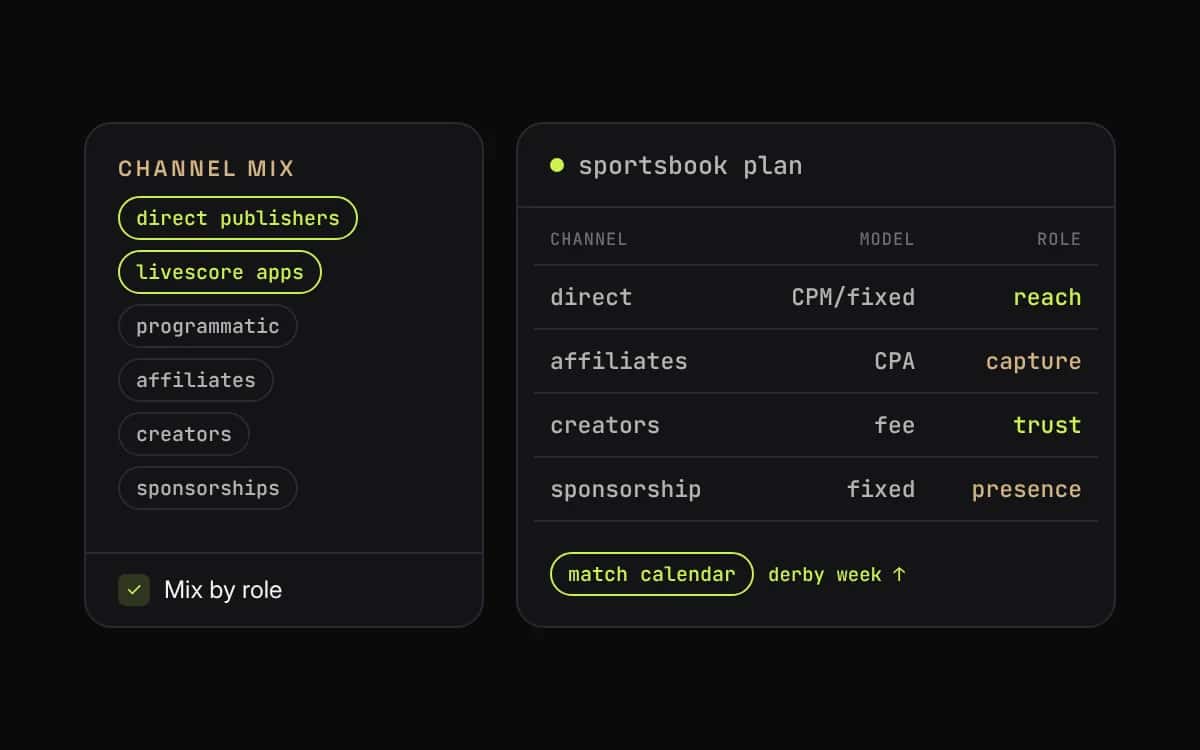
Sportsbook marketing is everything a licensed betting operator does to win and keep players: paid media, affiliates, creators, sponsorships, CRM and the product itself. For acquisition, the channels that work best in 2026 put the brand next to live sport:
- direct placements on sports and livescore publishers
- odds and match-centre integrations
- creators who already talk to bettors
Affiliates and programmatic add volume, and sponsorships add presence around big events.
This guide covers each channel, what it costs, how to plan around the sports calendar, and which KPIs to use.
What sportsbook marketing covers
Sportsbook marketing has two jobs:
- Acquisition: getting new players to register and make a first deposit. Paid media, affiliates, creators and sponsorships do most of this work.
- Retention: keeping players active through CRM, promotions, loyalty and the product experience.
This guide focuses on acquisition, because that is where most of the budget goes and where channel choice makes the biggest difference.
The sportsbook marketing channel mix
| Channel | Buying model | Typical use | Placement control | How it's measured |
|---|---|---|---|---|
| Direct sports and livescore publishers | CPM or fixed fee | Reach and consideration next to live sport | High | Delivery, clicks, registrations, FTDs per placement |
| Programmatic (private deals) | CPM | Scaled reach on approved inventory | Medium | Impressions, clicks, conversions in the DSP |
| Ad networks (pop, push, native) | CPC or CPM | Fast tests and volume | Low | Clicks to FTD in your own tracker |
| Affiliates | CPA, revenue share or hybrid | Paying for results | Medium | FTDs and player value per affiliate |
| Creators (streamers, tipsters, Telegram) | Fixed fee, often plus revenue share | Trust, launches, big matches | Medium | Promo-code and link conversions per creator |
| Sponsorships (publisher, team, event) | Fixed fee | Brand presence around competitions | High | Visibility, reach, brand-search lift |
No single channel does everything. A common set-up is:
- direct publishers and creators to build demand
- affiliates to capture players who are ready to bet
- sponsorships to own key competitions
Sportsbook advertising formats that work
The formats that perform best for sportsbooks sit inside the sports experience, not around it:
- Odds units and odds widgets: live odds for the match on screen, with your brand and a bet button. This is the most relevant format for a sportsbook.
- Match-centre sponsorship: "presented by" branding on match, league or competition pages.
- Sticky banners (320x50): pinned to the bottom of the app or mobile site while users follow scores.
- MPUs (300x250) and half-pages (300x600): in match lists and articles.
- Interstitials (320x480): full-screen between views. High impact, so use frequency caps.
- Event takeovers: multiple formats on one publisher around a final, a derby or a tournament.
Creative tip: show the actual fixture and live odds rather than a generic welcome offer. Match-specific creatives tend to get more relevant clicks. Every creative needs the age and responsible-gambling messaging required in each market.
For how to buy these placements on apps like Sofascore or Flashscore, see how sportsbooks advertise on livescore apps.
Planning around the sports calendar
Sportsbook demand follows the fixtures. Plan media in three layers:
- Always-on: a steady base on the leagues your players bet on most, all season.
- Peaks: extra budget around derbies, title deciders, cup finals and the start and end of seasons.
- Tentpoles: major tournaments, booked early because premium placements sell out.
Book premium placements for big events several weeks in advance, and prepare creatives for each key match before the event starts. Our 2027 sports calendar for iGaming media planning lists the dates to plan around, and the major sports event planning guide covers how to phase a campaign.
Sportsbook marketing costs
Direct sports and livescore media (CPM):
| Region | Typical CPM | Notes |
|---|---|---|
| North America | $4–10 | High-impact formats up to about $15 |
| Latin America | $1.50–6 | Most sports sites around $3; app inventory is often cheaper than web |
| Western Europe & UK | $1.50–3 | Premium placements up to about $6 |
| Central & Eastern Europe | $0.75–3 | High-impact formats at the top of the range |
| CIS & Caucasus | $1–2.50 | |
| South Asia | $1–5 | Wide spread between app and web inventory |
| Southeast Asia | $1–3 | |
| Africa | $0.50–1 | Premium placements up to about $4 |
Ranges are indicative, based on Impressax direct buys across more than 50 sports and news publishers in 2025–2026. Ranges for Central & Eastern Europe, South Asia, Southeast Asia and Africa are based on fewer publishers. Prices vary by format, season and match importance; this is not a quote.
Other channels:
- Affiliates are usually paid per first-time depositor (CPA), commonly from tens to several hundred US dollars depending on the market, or by revenue share.
- Creators are usually paid a fixed fee per post, stream or month, often with a revenue share on top.
- Sponsorships are priced as a fixed fee for the period and rights included.
For a full comparison of traffic sources, see where to buy iGaming traffic.
KPIs: from impressions to first-time depositors
Judge every channel on the same funnel:
| Stage | KPI | What it tells you |
|---|---|---|
| Reach | Impressions, viewability, frequency | Did the right audience see the ad? |
| Interest | Click-through rate, landing-page visits | Was the message relevant? |
| Acquisition | Registrations, first-time depositors (FTDs) | Did it bring new players? |
| Efficiency | Cost per registration, cost per FTD | Is the channel worth the money? |
| Value | Deposits, net gaming revenue per player, retention | Are the players worth acquiring? |
Use the same attribution rules across all channels, track every source with its own links, and compare channels on cost per FTD and player value, not on clicks. Our iGaming advertising KPIs framework goes deeper.
Compliance by market
Before any sportsbook campaign goes live, check:
- Licence: you hold a licence in every country you target, and the media partner can geo-target to those countries only.
- Age and audience: ads reach adults only, with the age warning required locally (18+ or 21+).
- Responsible-gambling messaging: included in every creative where the market requires it.
- Bonus wording: offers and terms follow local advertising rules.
- Platform rules: each publisher, app and social platform has its own gambling policy, on top of national law.
Rules differ a lot by market and change often. For UK creative rules, see our ASA and CAP gambling ad rules playbook.
Frequently asked questions
What is sportsbook marketing?
Sportsbook marketing is how a betting operator attracts and keeps players: paid media, affiliates, creators, sponsorships, CRM and promotions. For acquisition, the most relevant channels place the brand next to live sport, on sports and livescore publishers.
What are the best marketing channels for a sportsbook?
Most licensed sportsbooks combine: direct placements on sports and livescore publishers for quality reach affiliates for results-based acquisition creators for trust sponsorships around key competitions Programmatic and ad networks add scale and testing.
How much does sportsbook advertising cost?
Direct sports and livescore media typically costs about $1–10 CPM depending on region. Affiliates are usually paid per first-time depositor or by revenue share. Creators and sponsorships are usually fixed fees.
Where should a sportsbook advertise?
Where bettors already are: sports news sites, livescore apps, odds and statistics pages, and creators who cover betting. Always only in markets where the sportsbook holds a licence.
How do you measure sportsbook marketing?
Track every channel to registrations and first-time depositors, and compare channels on cost per FTD and player value. Impressions and clicks only show whether the ad was seen and found relevant.
Do sportsbooks need a licence to advertise?
Yes. Publishers, platforms and agencies ask for a gambling licence for each target market, and advertising without one is illegal in most regulated markets.
What are the 5 Ps of sportsbook marketing?
The classic marketing mix applied to a sportsbook: product (markets, odds and features), price (margins, bonuses and free bets), place (the licensed markets and channels where you acquire players), promotion (advertising, sponsorships, affiliates and creators) and people (the team and partners who run and support it). For a sportsbook, promotion is planned around the sports calendar, and every element has to fit the licence and advertising rules of each market.
Plan your sportsbook media with Impressax
Impressax buys ads directly from sports, livescore and news publishers for licensed casino and sportsbook operators. Send us your markets, budget and key fixtures, and we'll come back with a named-placement plan: publisher, format, country and CPM, line by line.
Book a 30-minute call · Request the media kit · See our direct media service.